Why The Most Expensive Key Machine Isn’t Necessarily the Best Investment
Posted by Cary Stevens, AKS on Oct 29th 2026
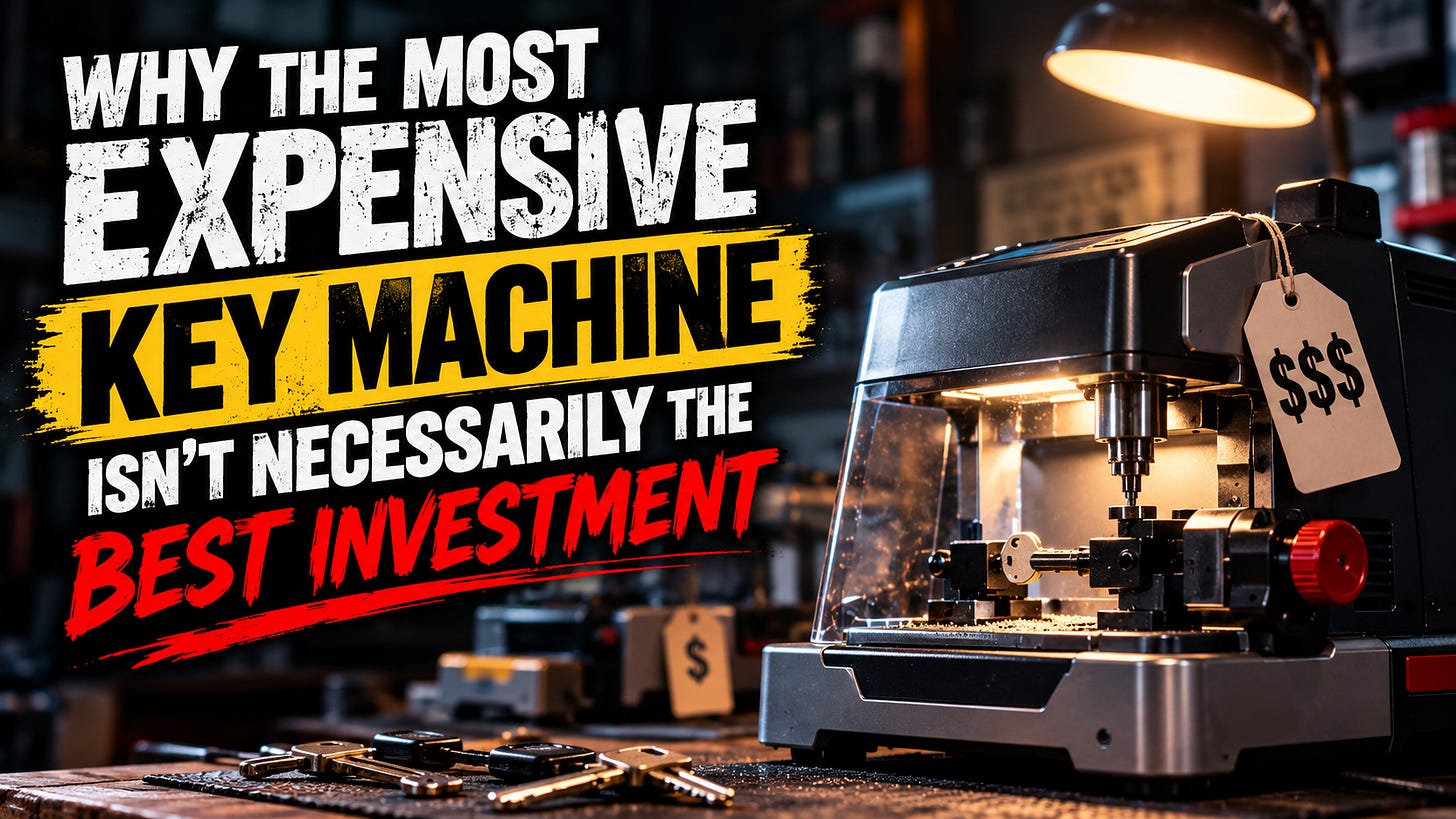
When shopping for a professional key machine, it’s natural to assume that a more expensive machine must be a better machine. After all, we’re talking about precision equipment. These machines need to cut keys accurately, operate reliably, and withstand years of daily use in a professional locksmithing environment.
But after years of working with key machines, their manufacturers, and the locksmiths who use them, I’ve learned that price doesn’t always tell the whole story. In fact, I think there are several important factors locksmiths should consider that often get overlooked when comparing machines.
Why Do Some Key Machines Cost So Much More Than Others?
Part of that difference comes down to manufacturing.
Companies like Ilco and Keyline manufacture professional key machines in Italy, where labor, facilities, and other manufacturing expenses can be significantly higher than in China. And make no mistake: these companies produce excellent equipment. Their machines are well-engineered, their hardware is high quality, and they’ve earned their reputations through decades of experience. But those manufacturing costs inevitably influence pricing.

Meanwhile, machines such as Triton, Black Widow, and Xhorse machines are manufactured in China, where production costs can be substantially lower.
Of course, anyone who has worked with Chinese manufacturers knows that quality can vary dramatically. Some factories produce exceptional products, while others focus primarily on making things as cheaply as possible.
The country of manufacture doesn’t determine the quality of a machine. The manufacturer’s engineering, components, quality control, and commitment to the product do.
The Triton and Black Widow machines are interesting examples. Despite their comparatively affordable prices, they offer extensive functionality, impressive hardware quality, and, in our experience, very low rates of machines requiring repair.
This challenges the assumption that a less expensive machine must involve significant compromises.

A Key Machine Should Keep Getting Better
With many traditional vehicles like my GMC, the features you get when you purchase the car are largely the features you’ll have for the life of the vehicle. Significant improvements often come with the next model year, meaning you need to purchase a newer vehicle to enjoy them. Tesla is helping to change that expectation by delivering software updates that can improve existing vehicles and introduce new functionality.
Why shouldn’t we expect something similar from professional key machines?
A locksmith might invest several thousand dollars in a machine they expect to use for many years. During that time, new vehicles will be introduced, new key types will appear, and new cutting requirements will emerge.
The machine’s ability to adapt to those changes can be just as important as its capabilities on the day of purchase. Different manufacturers approach this differently.
Some focus heavily on developing and introducing new machines. Others invest extensively in improving the capabilities of machines already in customers’ hands.
Both approaches can produce excellent products, but they can have very different financial implications for the locksmith.
Free Software Updates vs. Paid Updates
Some manufacturers, including Ilco and Keyline, have offered software updates or subscriptions that require additional payment to maintain access to certain new capabilities. Other manufacturers take a different approach.
For example, software updates for Triton and Black Widow have historically been provided at no additional charge, even as the machines have gained substantial new functionality.
Over the lifetime of a machine, that distinction can become significant.
And there’s another important consideration: How much new functionality is actually being introduced?
A machine that receives frequent updates adding new key types, improved processes, and additional capabilities may become substantially more useful over time. When evaluating a machine, I think it’s worth looking beyond the current feature list and examining the manufacturer’s history of development.
Is the machine getting better every year? And how much is it costing existing customers to benefit from those improvements?
It’s Not Just More Keys. It’s Entirely New Capabilities.
The Triton is a great example of how ongoing development can transform what a machine is capable of doing, sometimes introducing features that were never available when customers originally purchased their equipment.
Here are three examples that particularly impress me.

Engraving: More Than Just Cutting Keys
Think about the possibilities for personalizing keys, identifying key systems, branding products with your company’s logo, or offering additional services to customers.
It’s the kind of functionality that expands what a locksmith can do with equipment they already own, without requiring the purchase of a separate engraving machine for these applications.
Custom Keys: Don’t Wait for the Next Update
Traditionally, when a new key type enters the market, locksmiths may have to wait for their key machine manufacturer to add support for it. Depending on the manufacturer and the complexity of the key, that could mean waiting for a future software release.
With Triton’s custom key functionality, locksmiths can define their own key specifications and begin cutting a new key type themselves, potentially within minutes.

That’s a tremendous advantage for locksmiths who encounter unusual keys, specialized applications, or newly introduced key systems.
Instead of being completely dependent on the manufacturer’s development schedule, the locksmith has the flexibility to create a solution immediately.
To me, that’s a perfect example of technology empowering the person using the equipment.
Key Conversion: Turning One Key Into Another
What began as a relatively simple blade modification feature has evolved into an extensive collection of key conversion capabilities.
Originally, it allowed locksmiths to do things like cut the head off a conventional metal key to create a blade that could be installed in a flip-key remote, or cut the mounting hole needed to install a blade into an Autel universal remote.
Useful features, certainly. But the possibilities have expanded dramatically.
Today, Triton’s key conversion capabilities include applications such as:
-
Toyota key conversions: Modifying a Toyota LXP90 key into a thinner, single-sided 80K-series key.
-
Kwikset conversions: Cutting back the shoulder of a KW10 key to convert it into a KW5.
-
Schlage 5-pin to 6-pin: Cutting back both shoulders of a Schlage 5-pin key to accommodate a longer 6-pin application.
-
Schlage 6-pin to 5-pin: Shortening a Schlage 6-pin key by cutting off the tip to create a 5-pin key.
-
Schlage LFIC control keys: Modifying the shoulders and tip profile of a Schlage key to create an LFIC control key.
-
Honda motorcycle keys: Cutting a center groove into a Honda high-security automotive key to convert it for a high-security motorcycle application.
These aren’t simply additional key codes in a database. They’re new ways to use a precision cutting machine to modify existing keys for entirely different applications.
And many of these capabilities eliminate the need to stock an additional key blank or perform tedious modifications by hand. They can really save your butt when you don’t have the right key on hand.
The Bigger Picture
Engraving, custom key creation, and key conversion are three very different applications. Yet they all demonstrate the same philosophy: find new ways to make existing equipment more useful.
When a manufacturer keeps adding capabilities like these, the machine you own today can be substantially more valuable than the machine you originally purchased.
And when those software improvements are provided free of charge, the long-term value becomes even more compelling.

When New Capabilities Require New Hardware
Sometimes supporting a new key type genuinely requires additional hardware. A new cutter, decoder, jaw, or other accessory may be necessary because of the physical characteristics of the key.
But sometimes a clever engineering solution can eliminate the need for an expensive hardware upgrade.
Consider two real-world examples.
Medeco angled keys
When Triton added the ability to cut angled keys such as Medeco M3 and M4, it introduced a capability that would normally be associated with specialized equipment.
Rather than requiring an expensive replacement jaw assembly, the new functionality was made possible with a relatively inexpensive cutter and decoder set ($65).
Honda steel keys
When support for newer Honda steel keys became necessary, different manufacturers approached the challenge differently.
Some key machine platforms required customers to purchase additional jaws to accommodate the new key type.
The Triton development team found a way to support the key using the machine’s existing jaws and cutters. Not a single additional hardware purchase was required.
These examples illustrate something I think is extremely important: Engineering isn’t just about finding a way to make something work. It’s also about finding a way to make it work economically for the customer.
A manufacturer that actively looks for ways to reuse existing hardware can deliver tremendous long-term value.
The Importance of Listening to Locksmiths
At American Key Supply, we work with locksmiths every day. We hear about the features they love, the limitations they encounter, and the improvements they wish manufacturers would make.
We also have opportunities to communicate those suggestions directly to the companies behind the products we distribute.
One thing I’ve learned is that manufacturers differ significantly in how they respond to that feedback.
Some have extensive engineering teams and well-established development processes. Others operate with smaller, more specialized teams focused on a particular category of equipment.
What matters isn’t necessarily the size of the company. It’s how effectively customer feedback translates into product improvements.
Lock Labs, the company behind Triton and Black Widow in North America, has been particularly active in collecting locksmith feedback and working to incorporate it into ongoing product development.
Over the years, we’ve submitted numerous requests for improvements, and an impressive number have been implemented.
Not every suggestion is practical, of course. But that willingness to listen and continually refine the product has played a meaningful role in expanding the capabilities of these machines.
I believe this kind of collaboration between locksmiths, distributors, and product development teams is one of the most valuable forces driving innovation in our industry.
Don’t Overlook Service and Repair Support
And when your key machine is essential to your business, downtime can be expensive.
That’s why I think repair support should be a major consideration when selecting equipment.
Where will the machine be repaired? Is technical support available during normal U.S. business hours? Are replacement parts readily available? Will you need to ship the machine overseas? How quickly can you reasonably expect to get it back? Are loaner machines available to keep your business going while your machine out for repair?
These questions are especially important when purchasing equipment from international manufacturers.
Some brands have established domestic service networks, while others rely more heavily on overseas technical support or repair facilities. The experience may also vary depending on which distributor or dealer sold the machine.
Lock Labs, for example, maintains a service and repair operation in Las Vegas, Nevada, for Triton and Black Widow machines.
That means customers have access to domestic support and a U.S. repair destination rather than automatically needing to ship their equipment overseas.
Other established manufacturers also offer domestic support arrangements, and locksmiths should investigate the specific service options available for any machine they’re considering.
A machine’s real cost isn’t just what you pay to buy it. It’s also what it costs to maintain, update, repair, and keep working over its lifetime.

Looking Beyond the Price Tag
We have manufacturers with decades of precision-engineering experience, newer companies bringing innovative technology to market, and increasingly capable machines available at price points that would have been difficult to imagine years ago.
That’s great news for locksmiths.
But it also means buyers should look beyond traditional assumptions about brand reputation, country of manufacture, and purchase price.
When comparing machines, consider their current capabilities, the manufacturer’s track record of adding new features, the cost of software and hardware upgrades, the quality of the equipment, and the accessibility of technical support and repairs.
Most importantly, think about the machine you’ll own three or five years from now, not just the machine you’re buying today.
The best long-term value may not be the machine with the highest price tag. It may be the machine whose manufacturer works hardest to make your original investment more valuable over time.
And that’s a philosophy I believe deserves a lot more attention in our industry.
—Cary Stevens, AKS President
