Lock & Order: Unlicensed Activity Unit
Posted by Ryan Barbin, AKS on Oct 19th 2026
In the locksmith world, regulation is divided into two separate yet equally frustrating factions: the state agencies who enforce licensing laws, and the rogue locksmiths who defy them in the name of freedom, fast cash, and fewer forms.
These are their stories.
DUN DUN
The Gavel Falls
The courtroom is packed. The air smells faintly of brass shavings and coffee from a convenience store microwave. A jury of 12 locksmiths—some in polos, others in tactical pants—sit with folded arms and skeptical brows. The prosecution and defense sit at opposite tables, surrounded by binders, coffee mugs, and a pile of Lishi tools someone forgot to take off the evidence table.
A bailiff, wearing a tool belt instead of a gun belt, stands at attention. Judge Click McTurn enters the courtroom in a freshly pressed judicial robe, with his shoulder length, silver fox locks shimmering under the courtroom’s flickering florescent lights. A man of wisdom, style, and a strict “no bump keys in court” policy, he commands respect with every flick of his silver mane.
Judge McTurn (with a firm rap of the gavel):
"You may all be seated. Let’s unlock the truth, shall we?
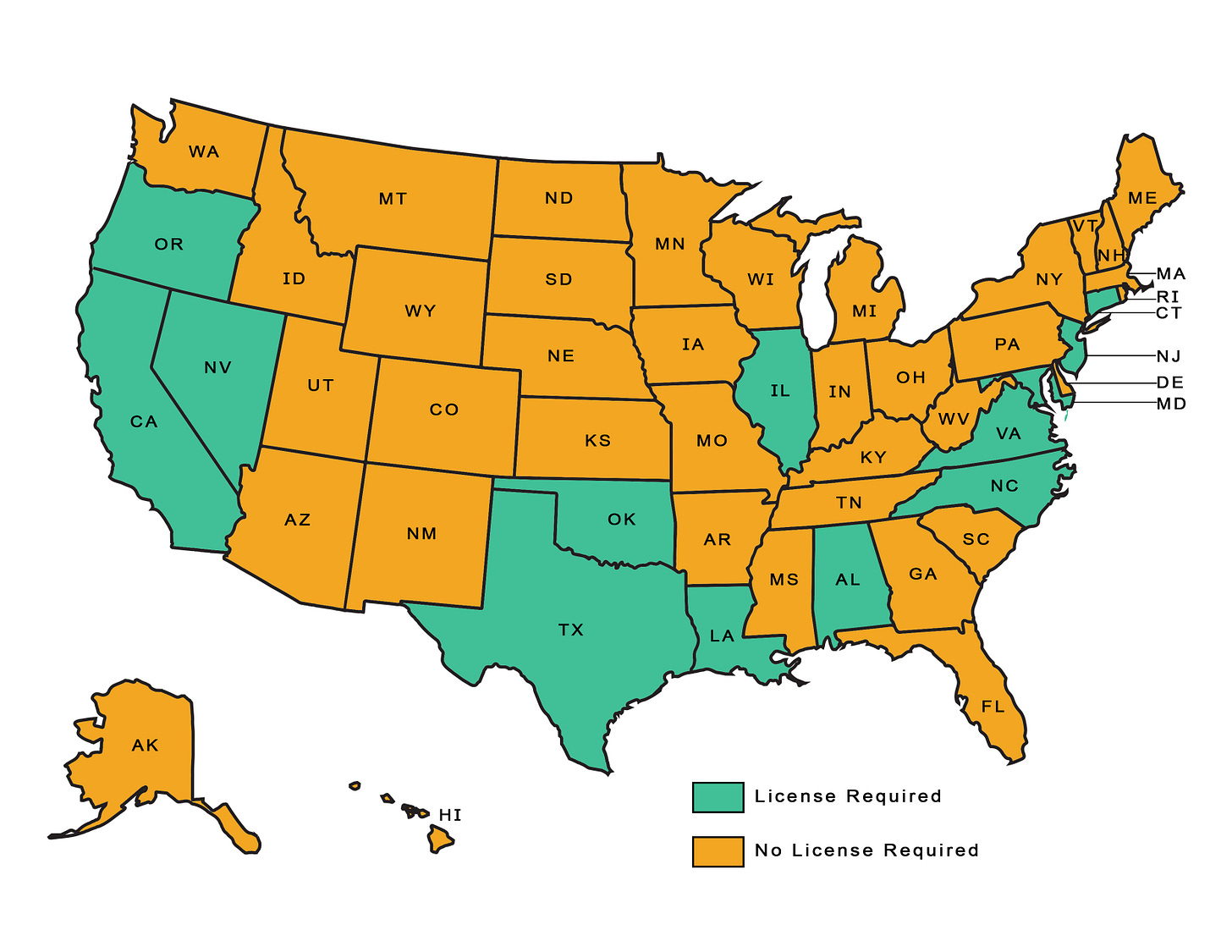
As it stands, there is no national standard for locksmith licensing. Requirements vary wildly from state to state, with only 13 requiring licensing. Some, like Texas and Louisiana, require licensing through a state agency, background checks, and even fingerprinting. Meanwhile, in states like Arizona, Florida, or New York, you can legally start picking locks the same day you learn how to spell 'Kwikset.’
Therefore, we have before us two parties: one defending the noble ideals of licensing; the other challenging its relevance, fairness, and very legality.
Representing the State and the licensing establishment, we have Ms. Mortise Cylinder, career legal counsel and proud owner of five laminated certificates.”
Ms. Cylinder nods solemnly, her briefcase labeled “EXHIBIT A – COMMON SENSE.
"And for the prosecution, arguing against the current licensing system, we welcome Mr. Van Keyring, defender of the independent locksmith, known in some circles as ‘The Freedom Key.’
We will now hear opening statements, beginning with the prosecution. Mr. Keyring, please approach the bench.”
Opening The Case
"Your Honor—Poof—esteemed jury—Poof—of my peers, and Ms. Cylinder—who I’m sure means well..."
He glances at her briefcase. She clutches it tighter.
"I stand before you today not as a scofflaw, nor a rebel without a certification—but as a working locksmith. A tradesman… a man who believes that access to honest work should not require a maze of forms, fees, and fingerprints just to open doors... when, ironically, that’s my actual job.
Licensing, currently is less about protecting the public—and more about protecting revenue streams. It’s a pay-to-play system, plain and simple. In states like Louisiana, you need to jump through more hoops than a golden retriever in a talent show. Meanwhile, you can drive one state over and legally start picking locks with nothing more than a van, a logo, and a dream."
Several jurors nod, especially the one wearing a “Trust Your Local Locksmith” trucker hat.
"We’re told it’s about safety—but where’s the national database? The standard training? The consistent enforcement? It’s patchwork regulation disguised as professional oversight. And the people paying the price? Small business owners. Immigrants. Blue-collar workers trying to feed their families without having to also feed the bureaucratic machine.
Ladies and gentlemen, this isn’t about ethics. It’s about access. And I’m here to argue that licensing, in its current form, is less a lock of protection—and more a deadbolt on opportunity.
With all due respect to my opposition, I honestly do not see a huge issue with background checks. I mean safety measures are important, but what good are they if the government doesn’t enforce them? What’s the point of having locks on doors, if you don’t actually lock them.”
He returns to his seat, adjusts his tie and wipes his brow, feeling proud but also a little worked up following his opening statement.
Judge McTurn, (spinning the gavel around in his hand like a rock and roll drummer): “The defendant may now approach the bench. Ms. Cylinder, are you ready?”
Ms. Cylinder (still clutching her briefcase, approaches the bench with the confident air of a runway model): “I was born ready, your honor.”
The Heat Is On
“Ladies and gentlemen of the jury, let it be known that The FTC (Federal Trade Commission) has issued multiple consumer alerts over the years warning of fake locksmith companies—especially in states with no licensing requirements. These scams often involve fake business listings on Google, bait and switch pricing (listed way lower and then skyrocketed up on site), and technicians with no background checks or verified identity.
In a 2017 investigation by the NBC Los Angeles I-Team, more than 50% of "local locksmiths" listed in online directories were either fake or unlicensed. Law enforcement often has no way to hold rogue locksmiths accountable in unlicensed states—there’s no registry, certification, or background info to trace. According to the Better Business Bureau, these scams are more commonly reported in states without license requirements. Many scams are run by call centers, not real locksmiths, and often use unvetted subcontractors. Victims report damage to their property, price gouging, and threats when they refuse to pay inflated costs.”
Ms. Cylinder blows right past the “opening statement” bar and just continues on into Exhibits B—through—Zed.
“Auto thefts…fraud…property damage…public safety…the reasons are far too many to even question. So…why, pray tell is this even up for discussion? I’ll leave you with that question!”
Ms. Cylinder closes up her briefcase and struts back to her seat, where her co-counsel leans over to her and whispers, “Slay!” and snaps her fingers in approval.
Judge McTurn scans the room and sees most of the courtroom attendees sitting on the edge of their seats, shoveling popcorn, peanuts, and Slim Jims into their mouths. The audience, clearly entertained to say the least, waiting and hoping to see how much better this circus could possibly get.
“Order! Order!” The Judge slams his gavel against the desk. “Get those snacks out of here! This is a LEGAL courtroom, not a Regal Cinema!”
Meanwhile, Mr. Keyring, literally dripping sweat from every pore he’s got, calls out, “Your honor, I’d like to present my first witness!”
Key Testimonies
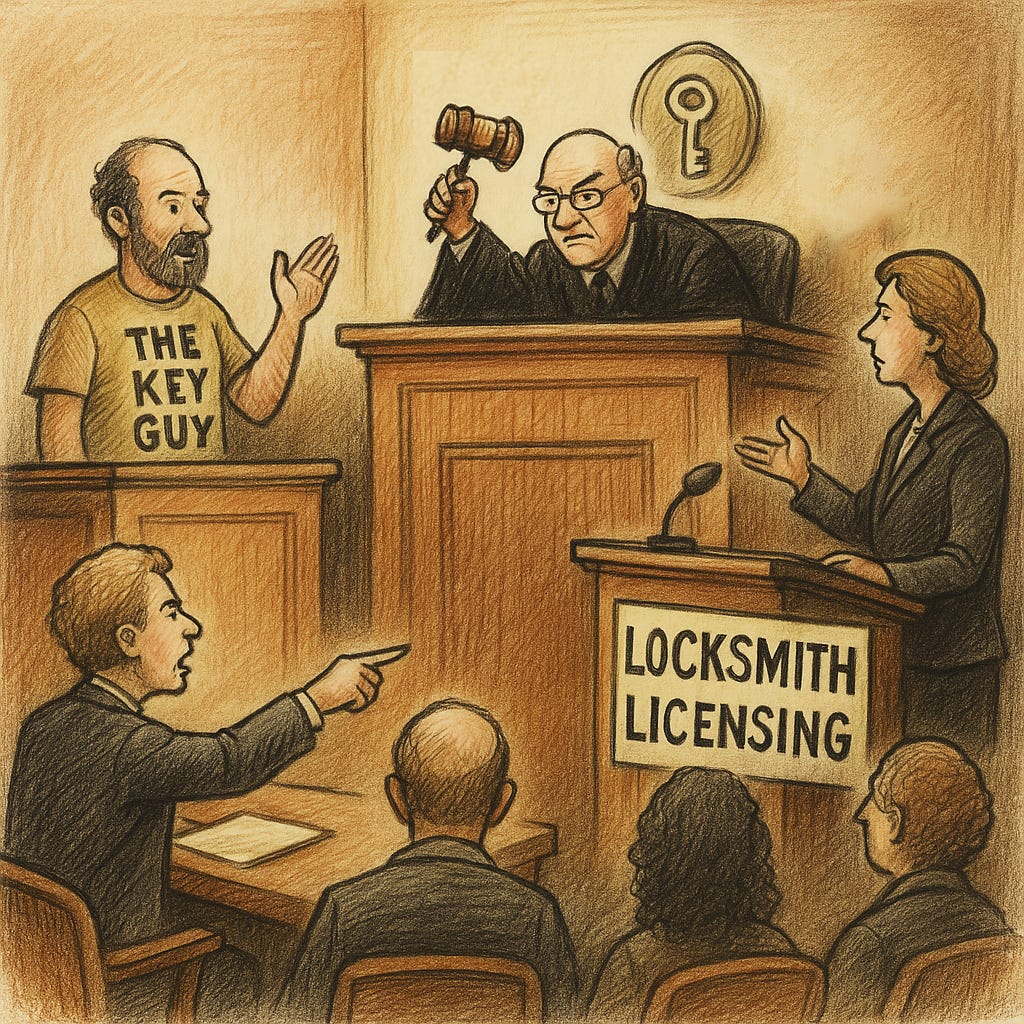
Witness #1 takes the stand—Joe “The Key Guy” — 25-Year Veteran Locksmith (Unlicensed). He wears a faded shirt that reads “If I Wanted to Be Regulated, I’d Be an Electrician.”
“I've been rekeying homes since dial-up internet, your honor. I’ve never had a complaint, a lawsuit, or a Yelp review below four stars. But I recently got fined for ‘unauthorized locksmith activity’ in a state I was just passing through. Didn’t even stop for lunch. Tell me how that protects the customer?”
Prosecution nods solemnly while holding up a receipt for a $275 fine labeled “Failure to Apply for Temporary Permit – Zone B.”
“Locksmith Licensing is in itself a great big con job. In every debate with locksmiths who advocate for licensing, there seems to be a sense of sudden silence when you challenge their positions. Then, they suddenly disappear when logic prevails.”
Keyring beams, nodding in agreement with his entire upper body like a bobblehead at a car show. The defense stares back—cold, motionless, and expressionless—like a Botox commercial directed by Wes Craven.
Witness #2 takes the stand—Nancy—the agoraphobic homeowner and neighborhood “cat lady”. Her hair has more bobby pins than a rebellious teens first lockpicking kit.
“I called a locksmith last month and someone showed up in a van with a duct-taped logo and no ID. Said he didn’t need a license. I just want someone I can trust, you know? Licensing might not be perfect, but at least it’s something.”
Defense passes her a tissue. Prosecution raises an eyebrow and whispers, “That van was probably licensed in Florida.”
Nancy continues, “After paying three times what I was originally told it would cost, I left him a negative review online—from which followed threats and demands that I take it down. Locksmithing is a business, and making threats over a negative review for poor business tactics is definitely out of line.”
A locksmith in camo Crocs leans over and mutters, “This case is more jammed than a Kwikset with a broken key.” The Croc’ed Crusader grumbles on, mostly to his coffee, “Back in my day, all you needed was a handshake and a hook pick!”
Nancy’s final line leaves the audience in emotional distress, as the Judge moves to closing statements. “You trust someone with your front door. That oughta mean something.”
Closing Arguments
"Before we bring this case to a close, let us revisit the core arguments—each as weighty and oddly shaped as a high-security sidebar key."
The Prosecution, Mr. Van Keyring presents:
Licensing is inconsistent, with some states requiring extensive background checks and fingerprinting, while others let you start a locksmith business with a van and a sticker.
It creates barriers to entry, especially for small businesses, immigrants, and self-taught tradespeople.
It's more revenue stream than public safety tool, offering no national standard, little oversight, and lots of paperwork.
In many states, enforcement is vague at best, giving a false sense of professionalism while punishing those just trying to work.
“In short, Your Honor, licensing is a deadbolt on opportunity—shiny, expensive, and ultimately optional for anyone who knows how to bypass it. Good locksmiths don’t need a license to be trustworthy—just skill, reputation, and maybe a five-star Google review or two.”
The Defense, Ms. Mortise Cylinder presents:
Licensing builds trust, giving customers peace of mind and a system of accountability in a field prone to scams and fly-by-nights.
It raises the standard for professionalism in a largely unregulated trade.
It helps weed out the bad actors, requiring background checks and ethical oversight.
In regulated states, customers have recourse, while unlicensed markets rely entirely on reputation (which isn’t foolproof).
It protects not just the customer, but the integrity of the trade itself.
“Without licensing, anyone with a coat hanger and ambition could call themselves a locksmith. And that, Your Honor, is how you get lawsuits and locked-out grandmas.”
Judge McTurn (picking up his gavel and a Slim Jim):
"And so, we reach the end of our deliberations. Two sides. One trade. One big, confusing set of state-by-state requirements that no one fully understands.
Is licensing the key to protecting the profession—or the lock keeping it from growing? That is up to the jury to decide.”
The courtroom deliberates and whispers grow in intensity like rain on a tin roof shifting into a full-out hail storm of gossip.
The Verdict Is YOURS
Some will proudly flash their laminated licenses like shields of honor. Others will keep their paperwork where they keep their old T-Code Pro—somewhere in the back of the van wedged between a broken probe and a melted air wedge.
Licensing may be a key to legitimacy... or just another lock keeping honest workers out.
To join or not to join, to license or not to license—these are the questions.
This court is adjourned.
The gavel has fallen.
The verdict… is yours.
DUN DUN
—Ryan Barbin, AKS
