Hidden in Plain Sight: The Invisible Industry of Locksmithing in Media
Posted by Ryan Barbin, AKS on Oct 20th 2026
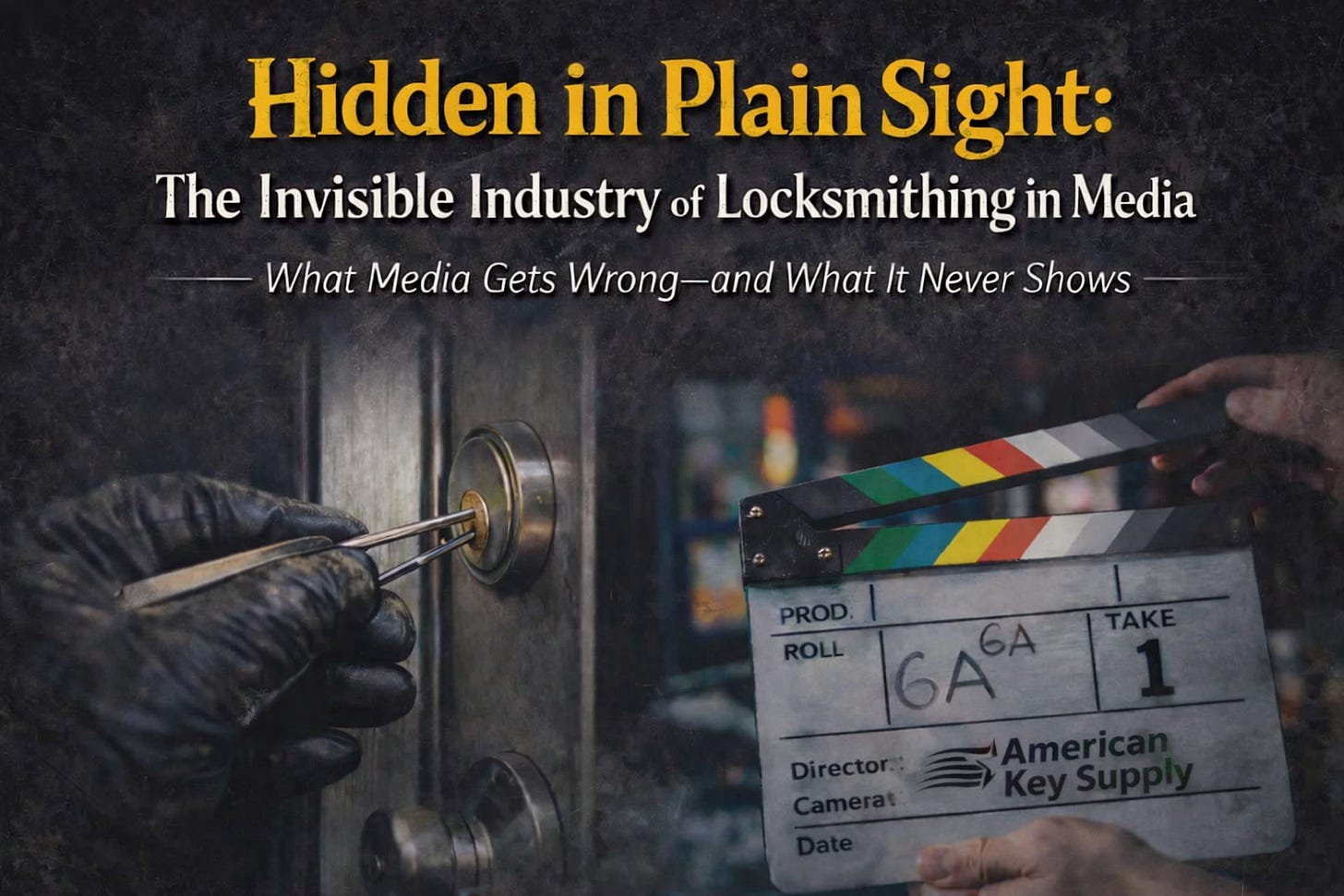
Before stepping into my role as Marketing Director at American Key Supply a year ago, the locksmithing industry was completely invisible to me.
I had never met a locksmith, never utilized their services, and honestly, I can’t recall ever even noticing a locksmith van on the road.
Funny how that works.
As humans, we can see something a thousand times—but until it becomes relevant, we don’t actually notice it.
It’s why certain jokes flew over our heads as kids but feel blatantly obvious as adults. It’s why after a breakup, suddenly everyone seems to drive the same car your ex did.
Your eyes don’t just see what’s there… they see what your mind is ready to recognize.
The rest? It stays hidden in plain sight.
The Moment It Clicked
He walked over to his locksmith van, decoded the key, inserted a key blank into a Keyline Bianchi 994 Laser key cutting machine, (We screenshotted and went on a hunting party of our own to figure out what machine it was—though currently discontinued.) The machine started cutting—the camera zoomed in tight—brass shavings flying as the blade carved through the key.

I just sat there for a second… kind of in awe.
It looked exactly like the close-up shots we capture when filming key cutting demos at AKS.
I grabbed my phone to record it and send it to the team. Not because I’m a locksmith—but because suddenly, it meant something to me.
And that’s when it hit me—
Had I really never seen a locksmith on TV before… or had I just never noticed?
I started to think and try to remember if I had ever seen such thing on a movie… maybe? No. Not that I could recall. Though perhaps I had and I just never paid it any mind. I know for a fact—if I had watched this exact scene a year ago, I wouldn’t have thought twice about it, and I damn sure wouldn’t have screen-captured it and texted my friends.
The Wrong Hands
Yikes!
It reminded me of a conversation I once had with my creative team, where I jokingly pitched the idea of directing a horror short film with a rogue locksmith as the killer.
Imagine someone running to their car, locking themselves inside for safety… only for the killer to calmly walk up, smile, and start cutting a key. Or pulling out a Lishi tool, “If it sticks…It Picks! Ba-ha-ha!” Another victim hides in a closet—only to watch an under-the-door lever opener tool slide across the floor and open it from the inside. The killer stands there like Jason Vorhees, holding a slim jim like a machete. She immediately pepper sprays him in the eyes with WD-40 and the chase continues.
I mean… it would probably make a hilariously awesome B-film.
Two words—Cult Classic.
But that idea led me to something bigger.
The more I started looking for examples of locksmithing in media, the more I noticed a pattern—these skills are almost always portrayed as tools for criminals, not professionals. The villain, not the hero.

And in a way… it makes sense.
One of the reasons the locksmithing industry feels so invisible to the outside world is because it has to be. It’s a closed circuit by necessity. The ability to decode, duplicate, program, pick, or otherwise gain entry—these are powerful skills. In the wrong hands, they don’t just open doors… they create opportunity for crime.
So the industry protects itself. It operates with a level of discretion, trust, and controlled access that most people never see—or fully understand.
That raises a bigger question—
Does that invisibility help the industry… or hurt it?
Does limited exposure, paired with unrealistic and often villainous portrayals in media, shape the way people perceive locksmiths? And more importantly… does it impact the future of the trade?
That’s the question worth exploring.
The Search Begins
What I discovered was a pretty wide range, from intense thrillers to absolute ridiculousness.
It was all right there. In movies, television series, books, video games, and even music. (Don’t worry, no one’s writing chart-topping hits about cutting keys… mostly just lock and key metaphors.)
And yet… it still felt hidden. Nowhere near as visible as other professions.
In some cases, the locksmith was even the main character—but rarely was the story centered around the profession. Instead, it focused on the skillset… usually used more mischievously than professional.
And more often than not—the characters weren’t locksmiths at all.
Not in the way a trained, licensed professional is.
More like calling a drug dealer the same thing as a pharmacist.
They just happened to have tools… and know how to use them a little too well.
Picking locks with bobby pins in seconds.
Using high-tech gadgets that don’t exist.
Unlocking car doors with tennis balls, cell phones, magic…apparently.
(MythBusters even debunked some of this… though it’s a mystery why they would even bother entertaining such absurdity.)
With locksmithing being a nearly 4,000-year-old profession, it’s no surprise the examples I found spanned generations.
The black-and-white noir film The Man in the Vault (1956) features a locksmith coerced by gangsters into robbing a safety deposit box containing $200,000.
Decades later, the story hasn’t changed much.

In the 2023 thriller The Locksmith, Ryan Phillippe plays an expert locksmith pulled back into a world of crooked cops and small-town crime after being released from prison. In the 2024 French crime thriller Night Call, a locksmith is framed for robbing a ruthless mob syndicate.
Different eras. Different stories. Same pattern.
Locksmithing, in the eyes of media, seems to matter most when it’s tied to crime.
And while that may make for a more dramatic plot, it overlooks the reality—
that in the real world, locksmiths are far more likely to help someone in a moment of panic than to cause it.
But that’s not the story we’re usually shown.
When I Grow Up…
Doctors, lawyers, cops, detectives—these professions are everywhere in books, movies, and television. While their portrayals are often exaggerated or dramatized, they’re still visible—and that visibility matters.
Those portrayals, accurate or not, inspire people. They influence career paths. They make someone think, “I want to be that.”
So… how many people watch television and say, “I want to be a locksmith?”
My guess? Almost none.
Though it’s not because the trade isn’t interesting or valuable—it’s because it’s rarely shown. Also, when it is, it’s reduced to picking locks, cracking safes, or aiding in some form of criminal activity.
Even in video games, where unlocking doors and safes is practically a core mechanic, locksmithing as a profession is almost nonexistent.
Take The Sims, for example. You can pursue a career as a scientist, doctor, musician—but locksmith has never been a playable career in any version of the game.
Oh, but the criminal career path has been an in-game option ever since the very first game’s release in 2000!

I did happen to discover that in The Sims Freeplay, there is an option to lookup and hire a locksmith from a computer. I wonder if any of our customers received that call?
Press X to Pick Lock
For decades, it’s been simplified into a mini-game: twist, turn, break a few picks, try again. However, in more recent years, there’s been a noticeable shift.
Developers have started incorporating elements that resemble real locksmithing—actual picks and tension wrenches, pin feedback, and more complex lock behavior. It’s a step closer to reality…but still a long way from it.
Even in newer titles and niche projects, realism tends to stop at the surface.

There’s even a Locksmith Simulator currently in development, aiming to capture more of the trade. While it introduces workbench tools and even key duplication machines, it still leans heavily into exaggerated, almost cartoonish gameplay.

Another title, Access Key (available on Steam), appears to go a step further—featuring recognizable tools like Lishi picks and punch machines. Though I haven’t played it myself, the inclusion of real-world tools is a notable step in the right direction.

Still…
For the most part, locksmithing in games mirrors what we see in movies and television—simplified, stylized, and rarely grounded in reality.
It’s there…but unless you’re looking for it, or you have a very keen eye for detail, you might just miss it entirely.

The Opportunity No One Sees
Answer: Because locksmithing should be seen.
Not just as the guy in a movie picking a lock in 3 seconds with a bobby pin… but as what it actually is.
A nearly 4,000-year-old trade.
A skillset built on precision, problem-solving, and trust.
A career where you can help people on their worst days, learn something new every week, work for yourself, or turn it into a full-blown business.
It’s not just unlocking doors.
It’s figuring things out.
It’s adapting on the fly.
It’s showing up when someone’s stuck, locked out, or completely out of options.
And honestly… it’s way more interesting than people realize.
Because beyond the tools and techniques, locksmithing is full of stories.
The random calls.
The weird customers.
The “how did you even manage to do this?” situations.
The late nights. The early mornings.
The car that shouldn’t exist… but somehow does.

Every job is different. Every situation unpredictable.
And if we’re being honest… that sounds a lot like a TV show.
We’ve got Duck Dynasty.
We’ve got Storage Wars.
We’ve got Dog the Bounty Hunter.
We’ve got entire networks dedicated to flipping houses, cooking food, traveling the world, and buying abandoned storage units hoping there’s a treasure chest inside.
But locksmithing?
Nowhere.
No “Locksmith Wars.”
No “Keys Gone Wild.”
No late-night ride-a-longs with a locksmith responding to chaotic lockouts and sketchy situations.
You can’t tell me it wouldn’t work—because it absolutely would.

It's exactly the reason we created the AKS Network, to host game shows, comedy sketches, interviews, tutorials, demos, and series designed to entertain, educate, and celebrate the locksmith industry.
In locksmithing, there’s plenty of both drama and comedy. There’s unpredictability, skills, and problem-solving. Tools and gadgets that already look like they belong in a spy movie—and on top of all that… there’s mystery.
How You See Me… How You Don’t
You can’t exactly broadcast every technique and trick of the trade to the world—that’s part of what keeps the industry secure and trustworthy. Simultaneously, that’s also what makes it compelling. It’s the magician’s effect.
You know something impressive is happening…
You just don’t fully understand how.
That curiosity—that “how did they do that?” feeling. That’s what keeps people watching.
Which is exactly why locksmithing doesn’t just belong in the background of someone else’s story…
It could be the whole show.
As it turns out, locksmithing was never missing. It has always been there—hidden in plain sight. Maybe it’s time we start showing it, and allowing the world to see it more clearly for what it really is…
a craft, a skill, and in many ways… a form of art.
There are still many aspects of this industry left to discover. I implore you to find them—to open the doors, explore what’s behind them, and see how it might shape the future of this industry for generations to come.
-Ryan Barbin, AKS
